Updating



iPhone Screenshots


iPad Screenshots


Description
The Scofield Reference Bible Commentary is a widely circulated study Bible edited and annotated by the American Bible student Cyrus I. Scofield, which popularized dispensationalism at the beginning of the 20th century. Published by Oxford University Press and containing the entire text of the traditional, Protestant King James Version, it first appeared in 1909 and was revised by the author in 1917
The Scofield Reference Bible had several innovative features. Most important, it printed what amounted to a commentary on the biblical text alongside the Bible instead of in a separate volume, the first to do so since the Geneva Bible (1560). It also contained a cross-referencing system that tied together related verses of Scripture and allowed a reader to follow biblical themes from one chapter and book to another (so called "chain references"). Finally, the 1917 edition also attempted to date events of the Bible. It was in the pages of the Scofield Reference Bible that many Christians first encountered Archbishop James Ussher's calculation of the date of Creation as 4004 BC; and through discussion of Scofield's notes, which advocated the "gap theory," fundamentalists began a serious internal debate about the nature and chronology of creation.
The Scofield Bible was published only a few years before World War I, a war that destroyed the cultural optimism that had viewed the world as entering a new era of peace and prosperity; then the post-World War II era witnessed the creation in Israel of a homeland for the Jews. Thus, Scofield's premillennialism seemed prophetic. "At the popular level, especially, many people came to regard the dispensationalist scheme as completely vindicated." Sales of the Reference Bible exceeded two million copies by the end of World War II. The Scofield Reference Bible promoted dispensationalism, the belief that between creation and the final judgment there would be seven distinct eras of God's dealing with man and that these eras are a framework for synthesizing the message of the Bible. It was largely through the influence of Scofield's notes that dispensationalism grew in influence among fundamentalist Christians in the United States. Scofield's notes on the Book of Revelation are a major source for the various timetables, judgments, and plagues elaborated on by popular religious writers such as Hal Lindsey, Edgar C. Whisenant, and Tim LaHaye; and in part because of the success of the Scofield Reference Bible, twentieth-century American fundamentalists placed greater stress on eschatological speculation. Opponents of biblical fundamentalism have criticized the Scofield Bible for its air of total authority in biblical interpretation, for what they consider its glossing over of biblical contradictions, and for its focus on eschatology.
The 1917 Scofield Reference Bible notes are now in the public domain, and the Bible is "consistently the best selling edition of the Scofield Bible" in the United Kingdom and Ireland.In 1967, Oxford University Press published a revision of the Scofield Bible with a slightly modernized KJV text, and a muting of some of the tenets of Scofield's theology. Recent editions of the KJV Scofield Study Bible have moved the textual changes made in 1967 to the margin. The Press continues to issue editions under the title Oxford Scofield Study Bible, and there are translations into French, German, Spanish, and Portuguese
Feature of Scofield Reference Bible Notes app
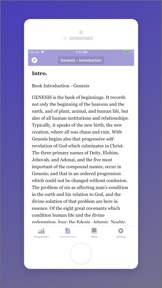
1. Bible Commentaries about books and Chapters of books
2. Navigate between books and chapters easily
3. Beautiful design and great user experiences
4. Track your progress reading book easily
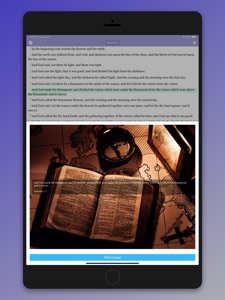
5. Share nice verses with beautiful background image.
6. King James Bible attached book
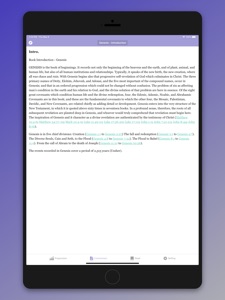
7. Clickable links to KJV verses!
8.Highlight/underline part of commentary
9.Add notes/bookmarks
Information
Developer
Categories
Version
1.0
Size
68.9 MB
Game Center
No
VPP Device Licensing
Yes
Rating
Rated: 4+
Compatibility
iOS 10.3 or later
Devices
iPhone 5, iPhone 5c, iPhone 5s, iPhone 6, iPhone 6 Plus, iPhone 6s, iPhone 6s Plus, iPhone SE, iPhone 7, iPhone 7 Plus, iPhone 8, iPhone 8 Plus, iPhone X, iPhone XR, iPhone XS, iPhone XS Max, iPhone 11, iPhone 11 Pro, iPhone 11 Pro Max, iPhone SE (2nd generation), iPad (4th Generation) (Wi-Fi), iPad (4th Generation) (4G), iPad (5th Generation) Wi-Fi, iPad (5th Generation) Wi-Fi + Cellular, iPad (6th generation) Wi-Fi, iPad (6th generation) Wi-Fi + Cellular, iPad Pro, iPad Pro (Cellular), iPad Pro (9.7-inch), iPad Pro (9.7-inch) (Cellular), iPad Pro 12.9-inch (2nd generation), iPad Pro 12.9-inch (2nd generation) Wi-Fi + Cellular, iPad Pro (10.5-inch), iPad Pro (10.5-inch) Wi-Fi + Cellular, iPad Pro (11-inch), iPad Pro (11-inch) Wi-Fi + Cellular, iPad Pro 12.9-inch (3rd generation), iPad Pro 12.9-inch (3rd generation) Wi-Fi + Cellular, iPad Air, iPad Air (Cellular), iPad Air 2, iPad Air 2 (Cellular), iPad Air (3rd generation), iPad Air (3rd generation) Wi-Fi + Cellular, iPad mini Retina, iPad mini Retina (Cellular), iPad mini 3, iPad mini 3 (Cellular), iPad mini 4, iPad mini 4 (Cellular), iPad mini (5th Generation), iPad mini (5th Generation) Wi-Fi + Cellular, iPad (7th generation) Wi-Fi, iPad Pro 11-inch (2nd generation), iPad Pro 11-inch (2nd generation) Wi-Fi + Cellular, iPad Pro 12.9-inch (4th generation), iPad Pro 12.9-inch (4th generation) Wi-Fi + Cellular, iPad Air (4th Generation) (Wi-Fi), iPad Air (4th Generation) (Wi-Fi + Cellular), iPad (8th generation) Wi-Fi, iPad (8th generation) Wi-Fi + Cellular, iPod touch (6th Generation), iPod touch (7th generation)
Languages
English
App Store: Customer Ratings
Ratings & Reviews
5.0 of 5 (1 Rating)
App Store: Customer Reviews
No Entry